
NewsSTAND · Local & National News · February 18, 2026
From Chaos to Competence: How Bennie Smith Could Turn the Shelby County Clerk’s Office into a National Model
Memphis data expert Bennie Smith has a plan to turn the “pack your patience” Shelby County Clerk’s Office into a fast, respectful, data-driven engine of service.


Written By JR Robinson
The daily cost of a broken Clerk’s Office
In Shelby County, a simple tag renewal can feel like losing half a day of your life. Residents routinely report standing in line for two to four hours, often turning up before doors open just to avoid being turned away. One Memphian who goes weekly for work described “best case” waits of 45 minutes ballooning into nearly three hours, while another arrived early at Millington only to spend over two hours before being helped.
For individuals, that means missed shifts, lost childcare windows, and the stress of wondering if you brought the right paperwork only to find out at the window that a misunderstanding sends you back to the end of the line. Businesses that manage vehicle fleets or handle frequent title work get hit even harder; a staffer who “goes to the Clerk” once a week is losing dozens of productive hours a month just sitting in lines. This isn’t just inconvenient — it functions like an informal tax on time that weighs most heavily on working families and small businesses.
When an office that nearly every resident must use develops a reputation for confusion, long waits, and inconsistent answers, people lose trust in local government. The message they hear is clear: your time doesn’t matter, and customer service is an afterthought. That is the culture Bennie Smith wants to flip on its head.
Who is Bennie Smith? Data, discipline, and public accountability
Bennie Smith is not a career bureaucrat; he is a technologist and finance professional who has made a name for himself by following the numbers wherever they lead. In his professional life, he has worked in analytics, finance, and software development, including building applications for lender auditing at First Tennessee Bank and production metrics at International Paper. He has also served as a liaison between elected officials and IT for the City of Memphis, maintaining applications for the Traffic Violations Bureau, Memphis Police, and Internal Affairs.
Nationally, Smith is best known for his work in election integrity. As a Memphis-based financial analytics manager, he applied his skills to voting systems and discovered a high-risk mechanism in election software that could turn whole votes into fractions, effectively “weighting” elections so some votes counted more than others. His findings were covered by Bloomberg Businessweek, PBS NewsHour, and other national outlets, and he now serves as a Tennessee state election commissioner and technical advisor on election security.
That background matters for Shelby County. Smith has built his reputation on spotting system failures others miss, documenting them with data, and then pushing for solutions that are auditable, transparent, and practical. He is now bringing that same mindset to an office that touches almost every household and business: the Shelby County Clerk.
From “pack your patience” to performance standards
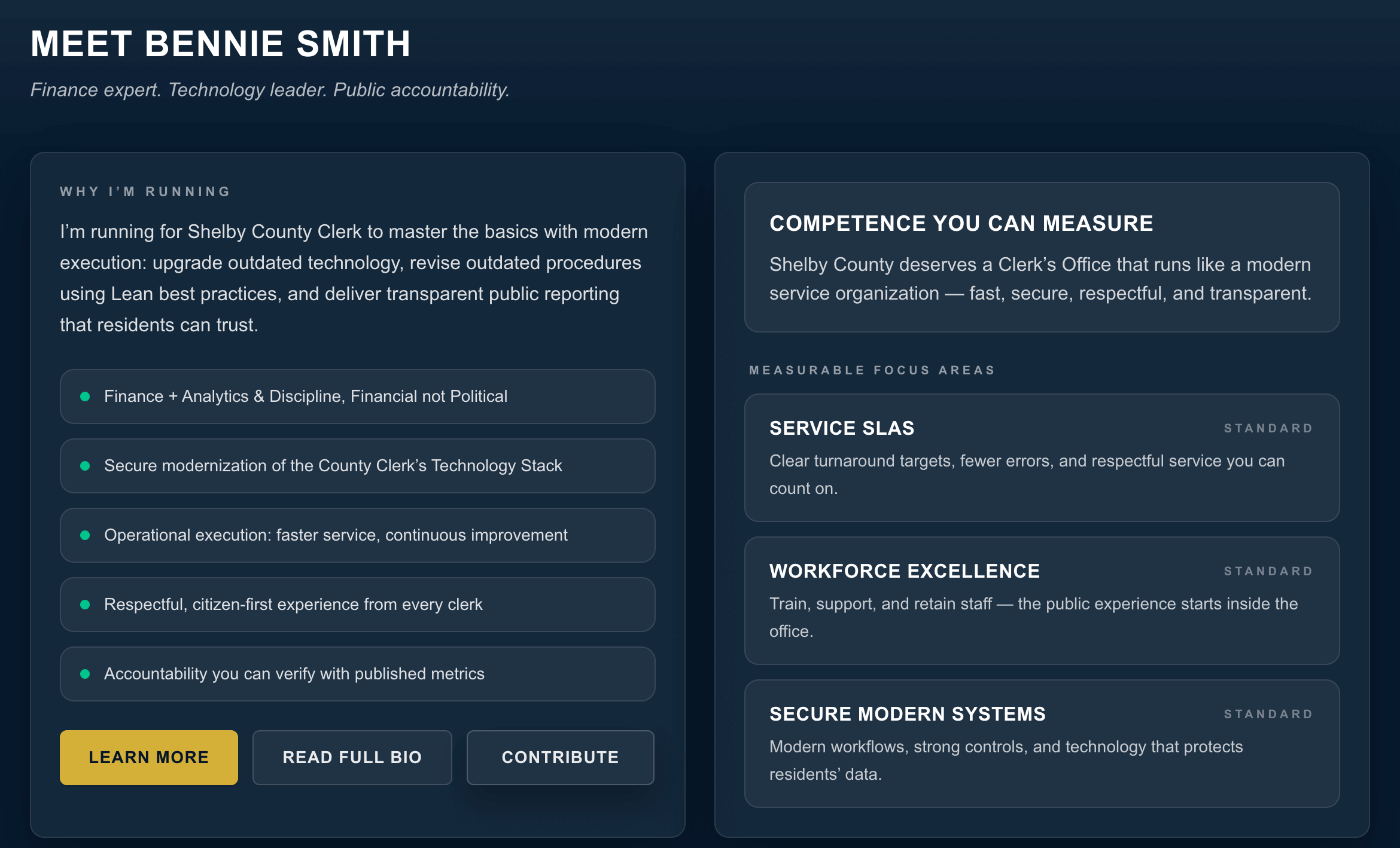
On his campaign site, Bennie Smith is blunt about the mission: “Modernizing the Clerk’s office with integrity and measurable results.” He frames his vision around what he calls ABC Principles — Automation, Better Pay, and Customer Focus — all anchored in public metrics that residents can see and understand.
At the core of his approach is the idea that the Clerk’s Office should run “like a modern service organization — fast, secure, respectful, and transparent.” That’s a dramatic contrast with the current expectation that citizens should “pack your patience” and plan for half a day of waiting to handle basic business. Instead of telling residents to lower their expectations, Smith wants the office to raise its standards and publish them.
He proposes clear service-level agreements (SLAs) — explicit targets for turnaround times, accuracy, and resolution rates — and then committing to hit those numbers consistently. In his framework, “Service SLAs,” “Workforce Excellence,” and “Secure Modern Systems” are not slogans; they are categories that each come with defined targets, like reduced wait times, fewer errors, and higher resolution rates. That means the public can move from anecdotes about bad experiences to data about how often the office meets its own promises.
Automation: Technology that actually serves people
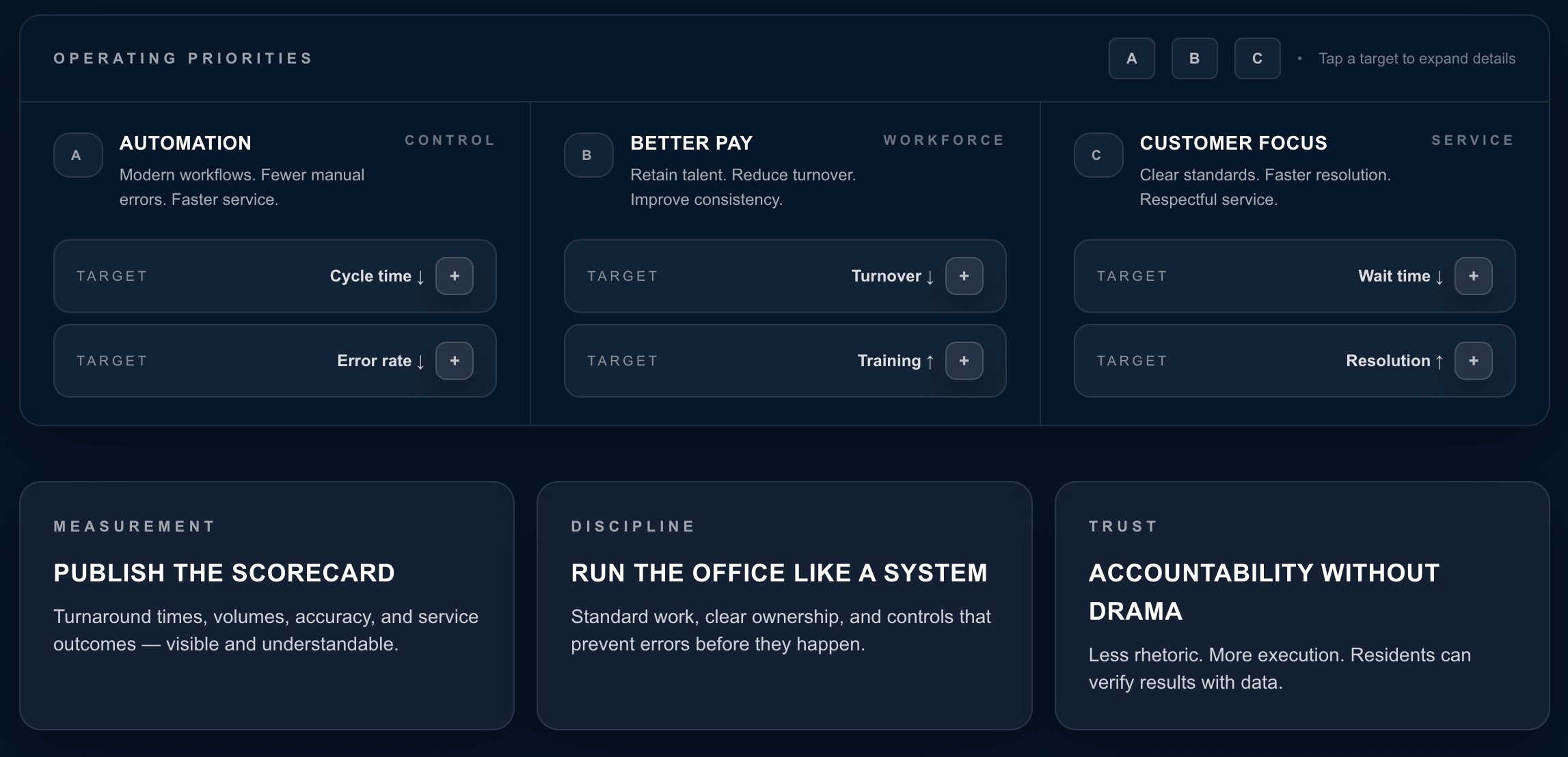
The “A” in Smith’s ABC framework stands for Automation — not for the sake of gadgets, but to cut cycle time and error rates. Today, much of the Clerk’s work is still wrapped in manual, repetitive processes: staff retyping information that residents already filled out, paper shuffling between internal desks, and limited digital self-service options. Every extra human handoff is another opportunity for delays and mistakes.
Smith’s plan calls for “modern workflows” that move information through the system once, cleanly, with strong controls to protect residents’ data. Automation in this context could mean:
-
Smarter online renewals and appointments that pre‑validate documents before you ever step into a line.
-
Digital queue management that gives residents realistic time estimates instead of leaving them guessing in a hallway.
-
Internal dashboards that flag bottlenecks in real time so managers can reassign staff before lines spiral out of control.
He talks about running the office “like a system”: standard work, clear ownership, and controls that prevent errors before they happen. Coming from someone who has spent years dissecting complex data systems, that commitment signals a shift from reactive crisis management to proactive design.
Better pay and workforce excellence: Fixing service from the inside out
The “B” in ABC is Better Pay. Smith is explicit that the public experience at the window starts with the experience inside the office. Underpaying front-line staff guarantees high turnover, uneven training, and a workforce that is constantly in “survival mode” instead of service mode.
His plan links better pay to measurable goals: reducing turnover, increasing training, and building what he calls “Workforce Excellence.” The idea is straightforward:
-
Pay competitively enough to keep good people.
-
Train them thoroughly on both policy and customer service.
-
Support them with systems that make their jobs easier, not harder.
When staff feel valued, supported, and equipped with functional tools, the culture shifts. Instead of clerks who seem rushed, defensive, or burnt out, residents encounter people who have the time and capacity to be respectful and solution‑oriented. That’s not just good for morale; it directly impacts how quickly and accurately tasks get done.
Customer focus and respect: Changing the culture, not just the software
The “C” in ABC stands for Customer Focus, and this may be the most visible change for residents. Smith emphasizes “clear standards, faster resolution, and respectful service” as core goals, with specific targets: lower wait times and higher resolution rates.
A customer‑focused office:
-
Publishes what documents you need in clear language, online and on‑site.
-
Uses signage and digital tools to guide people instead of leaving them to ask around in the lobby.
-
Owns mistakes, fixes them, and then corrects the process that allowed them to happen.
Smith also wants to “publish the scorecard” — turning around times, volumes, accuracy measures, and service outcomes into a public dashboard. When residents can see for themselves how long renewals are taking this month versus last month, or how error rates are trending, trust starts to rebuild. Accountability stops being a political talking point and becomes something you can verify.
Financial transparency: Showing where the money goes
One of the most powerful pieces of Smith’s vision is his Transparency Dashboard — a live preview of the kind of reporting he wants to make standard in the Clerk’s Office. The dashboard lays out real figures labeled as “Shelby County’s portion of County Clerk Net Receipts (Cash Basis)” as of February 12, 2026, with month‑to‑date collections of about 4.36 million dollars and year‑to‑date collections over 54 million dollars, along with forecasts and remaining amounts to collect.
The breakdown includes revenue from hotel‑motel taxes, car rental taxes, multiple wheel taxes, gasoline tax, and hybrid/electric vehicle registration tax, with clear dollar amounts for each line item. Smith labels this as a “preview of the transparency dashboard we will publish — clear inputs, clear outcomes, and simple accountability. These numbers are real.”
For residents and businesses, this kind of clarity matters. When you can see what the Clerk’s Office is collecting, how it aligns with forecasts, and how those funds connect to public outcomes, you can ask better questions and spot problems early. For the office itself, this level of financial analytics allows leaders to forecast staffing needs, plan technology upgrades, and measure return on investment in a way that is visible to everyone.
From worst to best: What a modern Clerk’s Office would mean for Memphis
If Bennie Smith’s approach is implemented fully, the impact would ripple far beyond shorter lines. A modern, data‑driven Clerk’s Office would:
-
Give working parents back hours each month by turning all‑day chores into predictable, one‑hour tasks.
-
Help small businesses operate more efficiently by making fleet registration and title work faster and more reliable.
-
Improve staff retention and morale, which in turn produces more consistent, courteous service.
-
Reduce errors and backlogs through automation and clear standard work.
-
Restore public trust by putting performance and financial data out in the open for everyone to see.
Smith talks about “accountability without drama” — less rhetoric, more execution, and results residents can verify with data. Coming from someone who has already reshaped national conversations around election technology, that promise carries weight. He has “receipts” in the literal sense: documented financial and operational metrics, and a history of using analytics to protect the public interest.
Shelby County doesn’t have to accept two‑hour lines, confusing processes, and a culture of “that’s just how it is” at the Clerk’s Office. With the common‑sense use of technology, fair pay for staff, and a deep respect for the people this office serves, the same systems that once made life harder for Memphians could become a source of pride — a national example of how data and discipline can turn an everyday government office from worst in the country into one of the best.
Know someone who should read this?
Dive into our quick-start guides for Business, Enterprise, and Partner users—see how easy it is to grow faster, connect better, and dominate your market!